Hello Me Ơi
A parenting companion that gives mums advice grounded strictly in expert literature — not the internet, not the model's best guess. Just the books that actually know what they're talking about.
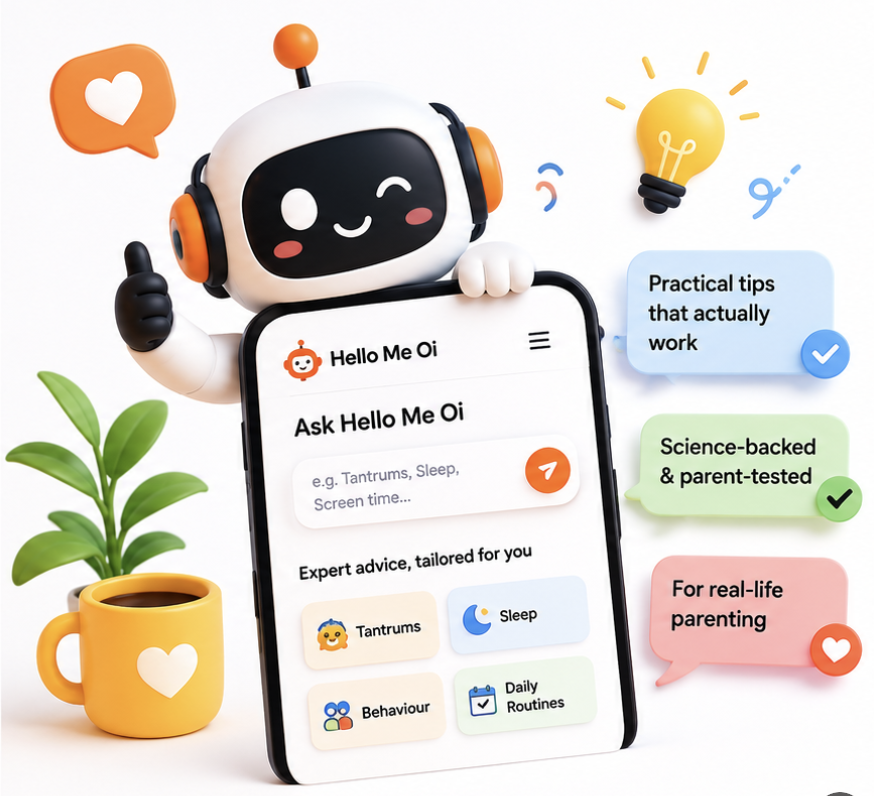
// the problem
Parenting is full of moments that need a thoughtful response right now: a child's meltdown, a tricky behaviour pattern, a developmental question that feels urgent at 10pm. The options are usually: Google (overwhelming, inconsistent, anxiety-inducing), parenting forums (well-meaning, often contradictory), or waiting until you can reach someone who knows. Most mums know what good parenting advice feels like — calm, specific, grounded in actual expertise — but they can't access it in the moment they need it.
This project started as one of my earliest builds, using no-code tools (Thunkable, Glide) before the infrastructure existed to build it properly. The core idea was right. The tools weren't ready. Now they are.
// why this matters
The gap isn't information — there's more parenting content online than anyone can read. The gap is trust and context: advice that's grounded in something reliable, specific to this mum's situation, and delivered in a tone that doesn't add to her stress. A RAG-powered assistant — one that retrieves from a curated expert knowledge base rather than generating freely — addresses all three. The mum knows exactly where the advice is coming from. So does the app.
// how it works
On onboarding, a mum shares a little about herself: her children's ages, her parenting context, any specific areas she's navigating. That profile personalises every subsequent interaction.
When she describes a situation — "my three-year-old won't go to sleep without a two-hour battle" — the app performs a semantic search across a curated library of expert parenting literature (my own notes from books I've read and trust), retrieves the most relevant passages, and generates a response grounded strictly in what was retrieved. It never draws from the internet or the model's general training. The knowledge base is auditable: I know exactly what's in it, and I can add, update, or remove sources.
If the app detects that the mum sounds stressed, overwhelmed, or distressed, it shifts register — less structured advice, more acknowledgement first. And when a situation is outside the scope of the knowledge base (medical concerns, mental health crises), the app says so clearly and signposts appropriate professional support rather than attempting to answer.
A simple feedback loop — did this help? — closes the loop on each interaction and informs future retrieval weighting.
// trade-offs i made
Using RAG rather than open-ended generation was both an architectural and a safety decision. Open generation is more flexible but fundamentally unauditable: you can't verify where the response came from or guarantee it reflects expert consensus. RAG constrains the output to a known corpus. That's a feature, not a limitation — especially when the user is a mum acting on the advice in a real parenting moment.
The hardest scoping decision: what stays out of the knowledge base. Medical advice, clinical mental health guidance, and anything requiring professional assessment are explicitly out of scope. The app is a knowledgeable companion, not a clinician. Designing the refusal gracefully — so it doesn't feel like a wall but a redirect — was as important as designing the answers.
// trust & safety
RAG as a safety architecture: the app never generates from training data or the internet — only from a curated, maintained knowledge base of expert parenting literature. Explicit out-of-scope handling for medical and mental health situations, with clear signposting to professional resources. Emotional tone detection to shift register when a mum sounds distressed. No parenting advice framed as prescriptive — always as suggestions to consider, not instructions to follow.
// what i learned
The original Thunkable/Glide version proved the concept but exposed the ceiling of no-code tools for anything requiring real retrieval logic or contextual personalisation. The idea was always right. The rebuild is about giving it the architecture it deserved from the start.
// what's next
A v1 focused on a small cohort of mums I already know — tight feedback loop, fast iteration, constrained knowledge base. The goal is not scale first. It's: does this actually help a mum at 10pm on a Tuesday? Once that's true, everything else follows.