Mochi's World
A Japanese learning companion for parents of young children — turns everyday moments into structured, curriculum-tied practice you can use right now, wherever you are.
// the problem
Most language learning apps are built for self-directed adult learners sitting at a desk. They're not built for a parent standing in a supermarket with a three-year-old, wanting to say something useful in Japanese before the moment passes. The resources that do exist for early childhood language learning require the parent to already know enough Japanese to improvise — which is exactly what most parents don't have. The gap isn't motivation. It's the absence of a tool that meets the parent where they actually are: in the middle of ordinary life, with a child who's ready to absorb everything.
// why this matters
The window for language acquisition in young children is real and finite. What happens between ages 3 and 6 — the incidental exposure, the repeated small moments, the parent modelling language naturally in context — matters more than any formal curriculum. Mochi's World is built for that window: not a classroom substitute, but a way to make the moments parents are already having with their children count linguistically.
// how it works
Three modes, each designed for a different kind of moment.
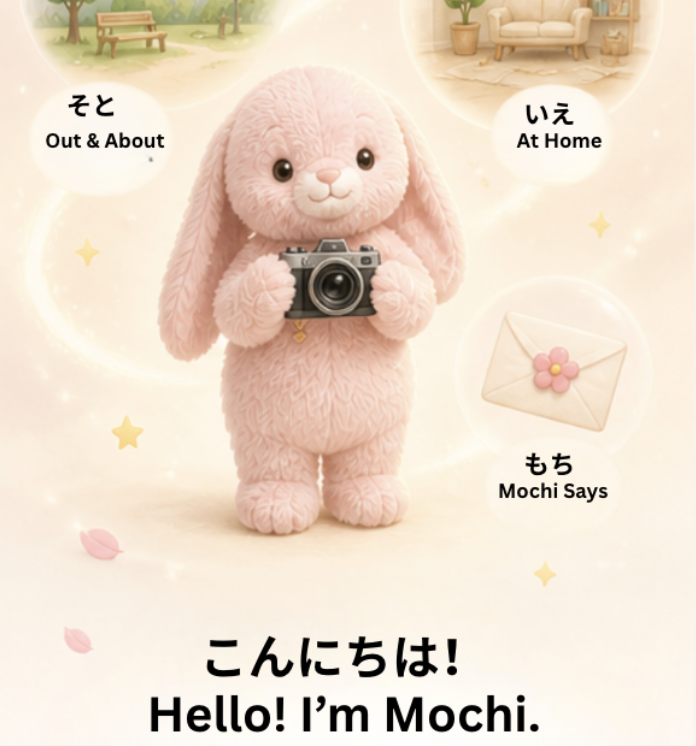
In the Wild — the parent takes a photo of whatever is around them: a park, a kitchen, a shop aisle. The app analyses the image, maps it to the current curriculum week, and generates the right Japanese vocabulary, verbs, and adjectives for what's in the photo — plus a modelled parent-child exchange the parent can use immediately. The camera becomes a curriculum tool.
At Home — the parent chooses a scene or free practice session. The app generates activities drawn from that week's vocabulary and grammar: games, prompts, exchanges. Structured but flexible.
Mochi Says — a one-tap daily challenge from Mochi, the app's character. No decisions required from the parent. One small practice moment, surfaced at the right time.
All three modes are tied to a weekly curriculum, so the vocabulary builds progressively rather than being a random collection of words.
// trade-offs i made
The most important architectural decision was making the parent the operator, not the child. Most edtech apps try to put the child in control of their own learning. For ages 3–6, that's the wrong model — the parent is the language environment. Designing for the parent's workflow (quick, mobile, moment-triggered) rather than the child's attention span was the right call, but it meant every interaction had to be genuinely fast and frictionless. If it takes more than two taps to get to a usable prompt, the moment is gone.
The curriculum structure was a deliberate constraint. It would have been easier to build a free-form vocabulary generator. But free-form doesn't build language — repetition and progression do. Tying every mode to the same weekly curriculum means In the Wild, At Home, and Mochi Says are all reinforcing the same material, even when the parent doesn't consciously coordinate them.
// trust & safety
The child is the learner but never the direct user of the app. All content is curriculum-scoped — the AI generates within the bounds of that week's vocabulary and grammar, not freely. No child data is collected. All Japanese content is generated in polite, age-appropriate form throughout.
// what i learned
In the Wild is the most technically interesting mode and the most differentiated feature in the market. It's also the one that most surprised me in testing: parents don't just use it in obviously "educational" moments — they reach for it at the dinner table, in the car, during bathtime. The camera as a language trigger turns out to be more natural than a menu of topic categories. The lesson: the best interface is the one that fits the shape of the moment, not the shape of the curriculum.
// what's next
Progress tracking so parents can see what vocabulary their child has been exposed to across weeks. A "Mochi's favourites" feature — words or phrases the child has responded to particularly well, surfaced for reinforcement. And eventually, a companion Mandarin version sharing the same curriculum architecture.